Social Security is more than a date on the calendar. The age you claim can change your monthly income, the savings you draw on first, and the income a surviving spouse may receive. A useful decision starts with your household’s needs, rather than a rule that everyone should claim as soon as possible or wait as long as possible.
Our Social Security presentation explores the essentials, benefit options, and questions worth asking before you apply. This companion guide walks through those themes and connects them to a broader retirement income plan. The goal is to help you prepare for a thoughtful conversation, not prescribe one claiming age for every reader.
Start with your own earnings record
Before comparing claiming ages, confirm the information behind your estimate. Your personal Social Security record is more useful than a national average or a friend’s monthly payment. Review the earnings shown for each year, look for missing information, and note whether the estimate assumes you will keep working. A change in future work can change the numbers you are comparing.
Use the Social Security Administration’s benefits estimate to see amounts based on your record and different starting dates. Save the estimates with the assumptions attached. If you plan to stop work before claiming, adjust expected future earnings where the tool allows, rather than assuming your current salary continues until the benefit begins.
Bring those estimates into the same conversation as your spending and other resources. A benefit that covers much of one household’s essential spending may play a different role in another household’s plan. Our retirement planning checklist can help organize the other pieces before you decide which income source should start first.
Understand full retirement age and the cost of starting early
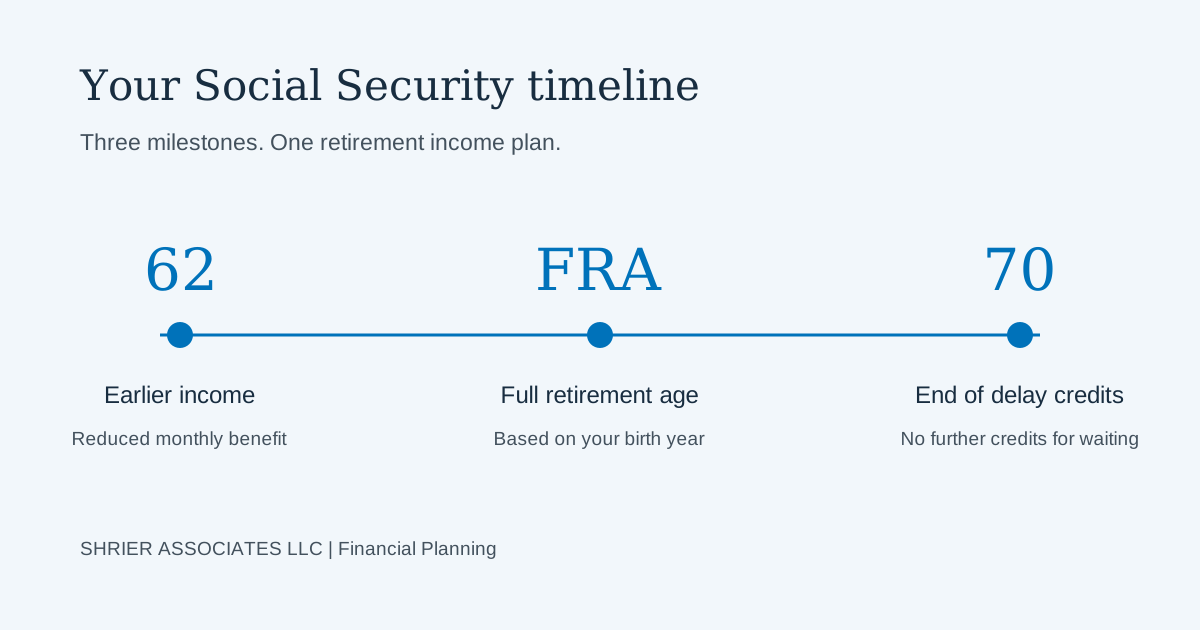
Full retirement age is the age at which you qualify for your unreduced retirement benefit. It depends on your birth year. It is 67 for people born in 1960 or later. For people born in 1956, it is 66 and four months. The SSA retirement-age chart provides the schedule and early-claiming reductions.
You can generally start retirement benefits at 62, but starting before full retirement age reduces the monthly amount. For a person whose full retirement age is 67, claiming at 62 means a reduction of about 30%. That tradeoff may still be appropriate when income is needed sooner, health changes the planning horizon, or continuing work is not realistic.
Compare what the smaller payment would mean for ordinary expenses over time. Do not look only at the first year. Ask how much of your housing, food, insurance, and other recurring costs the benefit would cover, and which resources would cover the rest. An early start solves one timing problem while creating a different long-term income pattern.
- Income now
- What expenses need to be covered before full retirement age?
- Income later
- How would a smaller monthly benefit fit later spending?
- Other resources
- What could cover the gap if you chose to wait?
Put the value of waiting in context
For people born in 1943 or later, delayed retirement credits increase the retirement benefit by 8% for each full year of delay after full retirement age, with monthly crediting. Those credits stop at 70. This is a benefit calculation rule, not an investment return, and the increase is not a promise that delaying produces the best lifetime outcome for everyone.
The presentation illustrates a person with a $2,000 monthly benefit at a full retirement age of 67. Under those assumptions, starting at 62 produces $1,400 per month, while starting at 70 produces $2,480. These are hypothetical amounts in today’s dollars, not a forecast of your payment. They show the monthly tradeoff without answering how long anyone will live.
Waiting also means paying expenses while the benefit is not arriving. Would wages cover that period? Would you need larger portfolio withdrawals? Would a market decline make those withdrawals harder to sustain? Review the bridge period as carefully as the later monthly benefit. Our portfolio management approach is part of that broader discussion about resources, risk, and financial objectives.
Consider longevity without pretending you can predict it
The presentation emphasizes that retirement can last many years. For planning purposes, it helps to consider more than one lifespan rather than rely on a single expected age. A longer retirement places more weight on dependable later income. A shorter horizon may change the tradeoff between receiving income sooner and receiving a larger monthly amount later.
A break-even calculation can help explain when cumulative payments under one claiming approach overtake another, but it is only one input. The answer depends on assumptions about lifespan, taxes, inflation, and what happens to money used or received in the meantime. Ask what changes when those assumptions change. A precise-looking age can hide a great deal of uncertainty.
For couples, look at the household across both lives. The question is not simply whether each person gets back a particular amount. It is also whether the household can meet expenses if one person lives much longer or if one benefit ends. Keep health and family history in the conversation without treating either as a prediction.
Know how working can affect payments in 2026
Claiming while working before full retirement age can trigger an earnings test. Under SSA’s 2026 working-while-receiving-benefits rules, $1 is withheld for each $2 of earnings above $24,480 if you are below full retirement age all year. In the year you reach that age, $1 is withheld per $3 above $65,160, counting earnings before the month you reach full retirement age.
From that month onward, earnings no longer cause withholding under this test. SSA also recalculates benefits at full retirement age to give credit for months affected by earnings-related withholding. These rules concern work earnings, not every dollar that arrives in your bank account, and special first-year rules can apply. Confirm the details before combining wages with an early claim.
Keep the earnings test separate from income taxes. The two use different rules, so passing one test does not answer the other question. Put expected wages, the benefit start month, and the dates of any work changes on one timeline. The dollar limits above are specifically for 2026 and should be checked again for later years.
Plan for the amount you keep after taxes
Social Security can be subject to federal income tax. SSA explains that combined income includes adjusted gross income, tax-exempt interest, and half of annual Social Security benefits. Benefits may become taxable above $25,000 for an individual filer or $32,000 for a joint return, and up to 85% of benefits may be included in taxable income. Married filing separately has different considerations.
“Up to 85% taxable” does not mean an 85% tax rate. It describes the portion of benefits that can be included in taxable income. The tax actually owed depends on the return as a whole. This distinction matters when comparing an estimated monthly benefit with the amount available to spend after taxes and other deductions.
Ask your tax professional to review planned withdrawals, investment income, and any proposed Roth conversion alongside the claiming decision. A transaction can affect several parts of the plan at once. Do not change accounts simply to reduce one tax measure without considering the wider result. Bring a recent return and a list of expected income sources to the discussion.
- Benefit estimate
- What monthly amount does your claiming age produce?
- Work earnings
- Could working cause payments to be withheld?
- Income taxes
- How much of your benefit may enter taxable income?
Review spousal, survivor, and former-spouse benefits separately
Family circumstances can change the choices available. A spousal benefit can be as much as 50% of the worker’s full-retirement-age benefit when the spouse claims at their own full retirement age. Starting early may reduce it. The SSA family-benefits guidance is the place to check eligibility. Do not assume you receive a full retirement benefit plus a full spousal benefit.
Survivor benefits follow different rules from benefits paid to a spouse while both people are living. For many applicants, deemed filing rules mean an application for retirement or spousal benefits also counts as an application for the other when eligible. Those rules do not apply to survivor benefits in the same way, which can allow different sequencing options.
If you are widowed or divorced, ask SSA to review all potentially relevant benefit types before filing. Marriage dates, divorce dates, remarriage, age, and the records involved can matter. Tell your advisor about the circumstances without assuming a past relationship is irrelevant. For couples, also review what household spending and income would look like after either spouse dies.
- Spousal
- Consider both records and the age each person claims.
- Survivor
- Review the income available after a spouse dies.
- Former spouse
- Ask SSA to confirm eligibility from your circumstances.
Check current pension rules before relying on older examples
The Social Security Fairness Act repealed the Windfall Elimination Provision, or WEP, and Government Pension Offset, or GPO, for benefits payable for January 2024 and later. SSA’s Fairness Act guidance explains the change. Older descriptions of those reductions should not be treated as the current rule for those benefit months.
If you receive a pension from work that was not covered by Social Security, check your current SSA record and any benefit notices. The repeal does not mean every pension recipient receives the same increase or qualifies for every benefit. Eligibility and the benefit amount still depend on the person’s circumstances. Ask SSA to resolve record-specific questions rather than estimating an adjustment from an old worksheet.
Turn the presentation into a practical planning conversation
Gather your current Social Security estimates, recent account statements, a spending summary, pension information if relevant, and a recent tax return. Write down your likely work end date and the claiming ages you want to compare. If you share finances, prepare both people’s information together so the discussion reflects the household rather than two isolated decisions.
Use our planning approach to connect the benefit choice with the life and financial objectives behind it. At Shrier Associates, the conversation can put Social Security alongside investments, spending needs, and other retirement resources. Questions about benefit eligibility belong with SSA, while tax and legal questions should be reviewed with the appropriate professionals.
You do not need to settle every detail before starting. A useful first meeting can identify missing information, explain the tradeoffs, and establish what to compare next. Contact our team to discuss how Social Security fits into your retirement planning. Bring questions about both the first years of retirement and the years when dependable income may matter most.
Read the Social Security presentation
Download the Social Security presentation (PDF) for the Fidelity educational material, including its examples, assumptions, and disclosures.
This article is for general education only and is not individualized investment, tax, legal, or Social Security advice. Hypothetical examples are illustrative and do not predict actual benefits or lifetime results. The original presentation is © 2025 FMR LLC. All rights reserved. Shrier Associates LLC is not the Social Security Administration.
Frequently Asked Questions
Is there one best age to claim Social Security?
No. The appropriate timing depends on income needs, health, work plans, other assets, and family circumstances. Compare the monthly benefit and the resources needed before it starts, then consider how the choice would work over different retirement horizons.
Does retiring from work mean I should claim immediately?
No. Your work end date and benefit start date are separate decisions. You may retire and use other resources before claiming, or keep working while receiving benefits. Review cash flow and the earnings test before deciding.
Do delayed retirement credits continue after age 70?
No. Delayed retirement credits stop at age 70. Waiting beyond that age does not add further delayed retirement credits to your retirement benefit.
Does an 85% taxable benefit mean an 85% tax rate?
No. It means up to 85% of the benefit can be included in taxable income, depending on your circumstances. Your actual tax depends on the full return and applicable tax rates.
Are WEP and GPO still in effect?
They were repealed for Social Security benefits payable for January 2024 and later. If an older estimate or presentation uses those reductions, check your current information with SSA before making a decision.