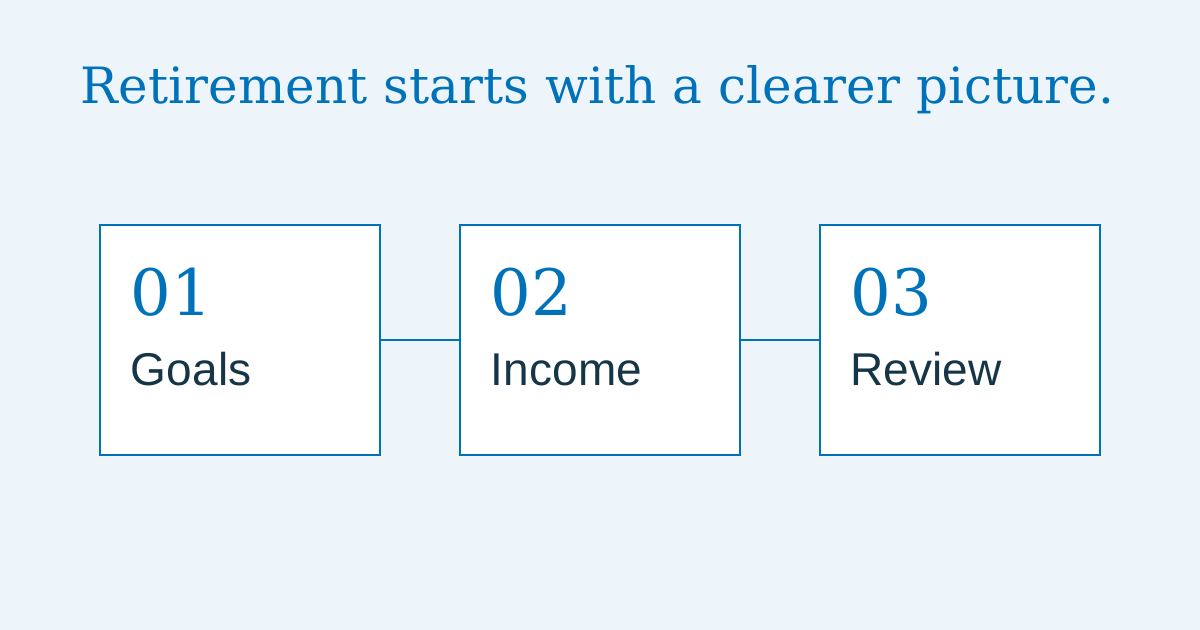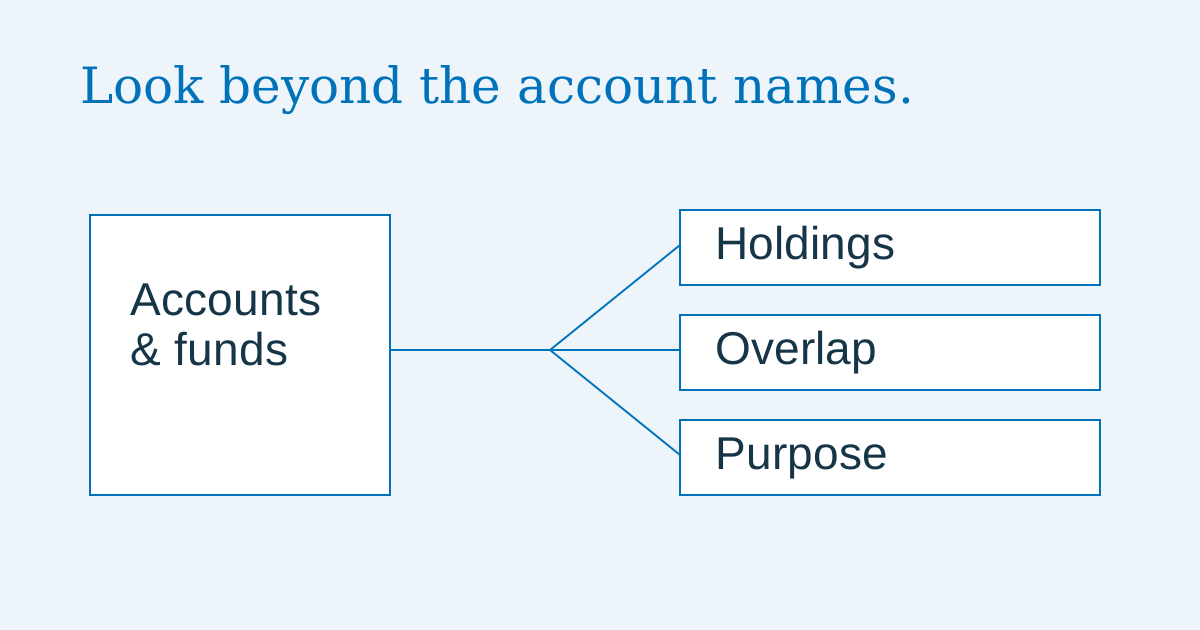
Owning several accounts does not necessarily tell you how your investments fit together. Different accounts can hold similar funds, and different funds can own some of the same securities. A useful diversification review looks through the labels so you can ask better questions about what you own and why.
This guide is a practical way to prepare for that review. It does not recommend securities, a target mix, or a trading strategy. The goal is to organize information, recognize questions, and discuss potential changes in the context of your own needs. Understanding comes before action.
Our investment management and financial planning services consider investments as part of a wider financial life. You can use the steps below whether your accounts are all in one place or spread across workplace plans, retirement accounts, and other holdings. A complete review should account for the information you can verify and identify what you still need.
1. Build one inventory before judging individual holdings
Collect current statements for the accounts you want to review. Record the account owner, account type, investment name, and approximate value using the same statement period where possible. Include workplace retirement plans and accounts you manage separately. Mark anything that is missing rather than treating an incomplete list as the whole portfolio.
Then describe the job each account is intended to do. One may support a goal several years away, while another is meant to help fund living expenses sooner. Ownership and purpose are not interchangeable. A retirement label describes an account structure, but it does not by itself explain how every investment inside that account serves your plan.
Keep the first pass simple. You are creating a reliable starting point, not a trading instruction. Avoid moving money just to make the list look tidier. Combining accounts can involve practical, tax, or plan-specific considerations that deserve separate review. A clear inventory lets you ask those questions with better context and reduces the chance of overlooking an account because it is inconvenient to access.
2. Look through fund names to the investments underneath
Use the fund’s own documents to understand its objective and holdings. A broad-sounding name may not tell you enough about the markets, companies, or investment types it emphasizes. Look at the actual information available rather than assuming two different names mean two different sources of risk. If a description is unclear, make that a question for the issuer or your advisor.
For a simple, illustrative exercise, imagine two accounts each holding a fund with a substantial emphasis on the same group of companies. The accounts remain separate, but part of the underlying exposure may overlap. This is not a claim about any specific product or a reason to sell either holding. It shows why counting account names is not the same as understanding what they hold.
You do not need to become a security analyst to make this review useful. Start by noting major holdings, investment categories, and any shared focus that stands out. Ask your advisor which overlaps are intentional and which deserve a closer look. The question is not whether every security must be different. It is whether the combined exposure is understood and appropriate for the purpose of the money.
- Account labels
- Where and how investments are held.
- Fund holdings
- The securities held inside each fund.
- Combined exposure
- What those holdings add up to across accounts.
3. Connect the mix to your goals and time horizons
Write down when you may need to use the money. A near-term expense and a distant goal create different planning questions, even when both matter equally to you. Avoid choosing a mix solely because it resembles someone else’s portfolio. Their timing, income, spending flexibility, and willingness to accept loss may be different from yours.
Investor.gov describes asset allocation as dividing investments among categories such as stocks, bonds, and cash, with time horizon and risk tolerance informing the decision. Diversification concerns the spread of investments. Neither concept turns a general educational description into a personalized recommendation.
For your own review, ask two separate questions: what level of loss could disrupt the goal, and what level of fluctuation would make it hard to remain comfortable with the plan? Record the answers in plain language. If retirement is approaching, our retirement planning checklist can help connect the portfolio discussion with expected spending and income. Those connections often matter more than a label such as conservative or aggressive.
4. Identify concentrations without jumping to a conclusion
Look for positions or shared exposures that seem especially important to your household. These could include a single company, an industry, or a geographic focus. An employer-related holding may also deserve discussion alongside your wages and other benefits. Make a note of what you find before deciding whether a change is needed.
A concentration is a question to understand, not proof that an investment is wrong. Ask how the exposure developed, whether it was deliberate, and what could happen if it performs poorly. If reducing it is worth considering, discuss the practical implications first. A choice that looks simple on a chart may involve taxes, restrictions, or other personal considerations.
Also ask whether holdings that appear different could respond to similar conditions. A stock fund and another stock fund do not become independent merely because separate firms manage them. At the same time, adding a product you do not understand can introduce new problems. The goal is an understandable portfolio, not the largest possible collection of names. Keep a list of questions rather than a shopping list of products.
- Purpose
- Why is this holding in the plan?
- Impact
- What could a loss mean for the household?
- Options
- What costs or constraints affect a change?
5. Review costs and risks alongside the investment mix
Ask what you pay at the investment level and the account or advisory level. The SEC’s Investor.gov guidance on fees explains that costs can meaningfully affect portfolio value over time. Request an explanation of the fees that apply to you, how they are charged, and what services or features you receive in return.
Do not judge suitability on cost alone. A lower fee does not answer whether you understand the investment, can access the money when needed, or are comfortable with its risks. Conversely, a higher fee should not be assumed to provide a better outcome. Ask for a plain-language explanation and keep it with the rest of your review notes.
Different investment types also have different risks. For example, Investor.gov’s bond guidance explains bond features and risks, including interest-rate and credit risk. The word bond should not be treated as a promise that an investment’s value cannot fall. A useful discussion names the relevant risks instead of relying on a reassuring category label.
6. Discuss rebalancing before making trades
Investment values change at different rates. That can alter the balance of a portfolio even when you have not made a new purchase. Before acting, compare your current holdings with the approach you had intended to follow. If you have no written target or review policy, first clarify the purpose of the mix rather than assuming any recent change must be reversed.
Rebalancing is a way of bringing a portfolio back toward an intended allocation. It is not a guarantee of profit or protection from loss. A discussion can consider whether contributions, planned withdrawals, or transactions might help address a difference. Which approach is appropriate depends on the accounts, the circumstances, and the implications of acting.
Ask what would trigger a review and who would be responsible for it. You might discuss a regular review schedule, an agreed change in the portfolio, or a change in your own circumstances. Keep market headlines separate from the process. A clear process does not remove uncertainty, but it can help avoid making every decision as a fresh response to the latest news.
Before approving a transaction, ask about costs, possible taxes, account restrictions, and whether the change affects another goal. If the reason for a proposed trade cannot be explained in relation to your plan, pause for a clearer explanation. Understanding the action matters as much as recognizing an imbalance.
- Compare
- Understand the intended mix and current holdings.
- Evaluate
- Discuss purpose, risks, costs, and constraints.
- Decide
- Choose whether action is appropriate for you.
7. Keep a written record of what you learned
Summarize the review on a page you can return to. Note the accounts included, the date of the statements, major questions, and any agreed next steps. If an account was excluded or information was unavailable, say so. A record with clearly stated limits is more useful than one that appears complete but leaves out an important part of the picture.
Separate observations from decisions. Finding an overlap is an observation. Deciding whether to change it requires context. Record the reason behind any decision, including a decision to leave a holding unchanged. Later, when markets or circumstances change, those notes can help you distinguish a new issue from an old question that was already considered.
Agree on who will do what next. You may need a plan document, an explanation from a fund company, or a discussion with your tax professional. For sensitive records, use the secure sharing method agreed with your advisor. Do not put account numbers, balances, or login details in a public website form. A useful review should improve clarity without creating unnecessary information risk.
8. Use a short checklist to keep the conversation focused
Before your next review, confirm that your account inventory is current, that you understand the role of the main holdings, and that your goals and timelines still reflect your life. Ask whether there are meaningful overlaps, whether costs are understood, and whether a change in work or family circumstances creates a reason to revisit the plan.
Do not turn the checklist into a scorecard. Having every document in order does not make investing risk-free. Diversification cannot ensure a profit or eliminate the possibility of loss. A thoughtful review is about making informed choices under uncertainty, not finding a combination of holdings that can promise a smooth path.
Leave the conversation able to explain your next step in your own words. That could mean providing a missing statement, getting an answer about an investment, or discussing a proposed adjustment. If a recommendation is unclear, ask for more explanation before you act. The ability to understand the decision is an important part of putting a plan into practice.
A broader conversation with Shrier Associates
At Shrier Associates, investment management sits alongside personal financial planning. Our investment philosophy puts drawdown risk at the center of the conversation. Our approach begins with understanding your circumstances, objectives, and risk tolerance. Our team can help you discuss the questions a portfolio review raises without separating your investments from the life they are intended to support.
You can schedule a conversation to explore your priorities. This article is general education, not individualized investment, tax, or legal advice. It does not recommend a particular investment or imply that any strategy can guarantee a result. Review tax and legal questions with your own qualified professionals.
Frequently Asked Questions
Does having more accounts mean I am more diversified?
No. Separate accounts may own similar investments, so account count alone does not describe the underlying spread of holdings. Look at the investments across the accounts together, while also considering ownership, taxes, and the purpose each account serves.
Can diversification prevent investment losses?
No. Diversification may help manage some investment risks, but it cannot ensure a profit or protect against every loss. Different holdings can decline together. Your review should consider both the investments and your ability to handle an unfavorable outcome.
Should I sell an investment when I find an overlap?
Not automatically. An overlap may be intentional or may warrant discussion. Consider the goal, size of the exposure, costs, possible taxes, and account restrictions before making a change. Identifying a question is not the same as deciding on a transaction.
How often should I review diversification?
Agree on a review process that fits your situation. A regular check-in can be useful, and a significant change in goals, work, family, or spending may call for an earlier discussion. A review does not mean that trading is required each time.