A portfolio can look varied on the surface and still leave important questions unanswered. You may have several accounts, funds, or investment names, yet much of the portfolio could be influenced by the same company, sector, country, or market event. Finding diversification gaps is not about making a portfolio complicated. It is about seeing what you own together and understanding what role each part is meant to play.
This guide offers a review process, not a recommendation to buy, sell, or rebalance. Start by gathering information, then identify questions worth discussing in the context of your goals, timing, taxes, and tolerance for loss. The SEC’s investor education guide makes an important distinction: asset allocation is personal, and diversification should be considered both across asset categories and within them.
If you are preparing for a conversation, our investment diversification review guide explains the broader review process. The questions below are a focused way to look for gaps without treating any one checklist as a substitute for advice tailored to you.
1. Begin with the purpose of the money
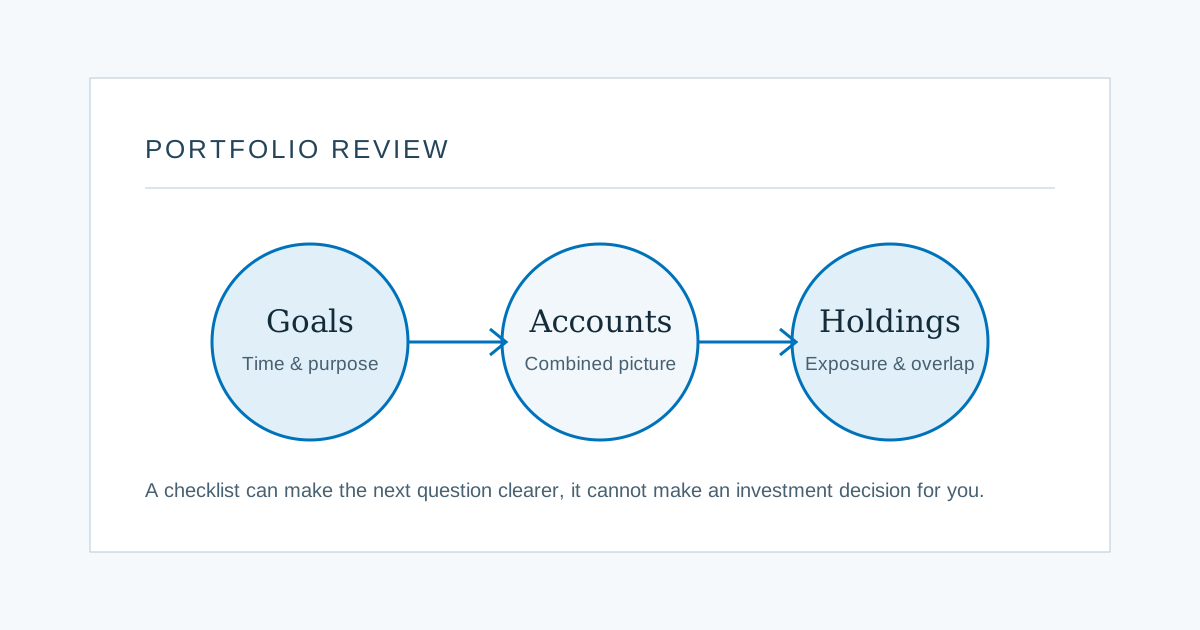
Before looking at percentages or fund names, write down what the money is for. A retirement account, a planned home purchase, a child’s education, and a near-term reserve may all have different time horizons and different jobs. A portfolio is not diversified simply because it contains several investments. It is diversified in a useful sense only when the mix fits the purpose and timeline of the resources behind it.
This first step keeps the review from becoming a hunt for a universally “balanced” allocation. The appropriate mix for one household can be unsuitable for another. The SEC notes that time horizon and willingness and ability to take risk are central to asset-allocation decisions. A shorter-term goal may call for a different conversation than a goal that is decades away. Record the goal, the likely timing, and whether the money may need to be used sooner than expected.
If retirement is part of the picture, it can help to connect this exercise with a broader retirement planning conversation. Investments are one part of the plan, alongside income needs, spending, healthcare, and the other decisions that may affect when and how money is used.
2. Make one complete inventory before judging individual accounts
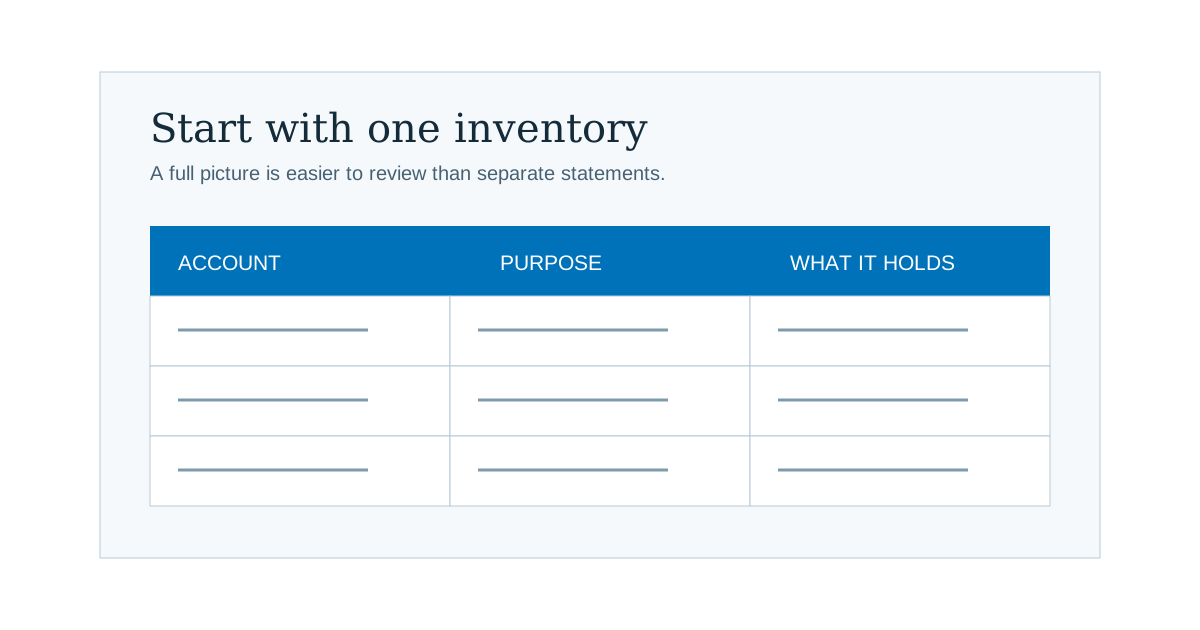
A common blind spot is reviewing each statement on its own. One account may look diversified by itself while another holds a similar collection of investments. Bring together taxable accounts, retirement plans, individual retirement accounts, employer plans, cash reserves, and concentrated company stock when they are relevant to the same household goal. You do not need to calculate a perfect answer on the first pass. You need a complete enough view to know what deserves a closer look.
For each account, note the owner, the purpose, the account type, and the holdings or fund names. Keep the latest statement, fund fact sheet, or plan website information beside the list. If an account is managed through an employer or another institution, record what you can confirm and flag what you cannot see. A missing detail is a question to resolve, not a reason to guess.
Also separate investable assets from resources that serve a different purpose. Emergency cash, a pension option, Social Security estimates, insurance, or a home may affect the overall plan, but they should not be casually treated as interchangeable with a marketable investment. The point is to understand the whole financial picture without blurring the job of each resource.
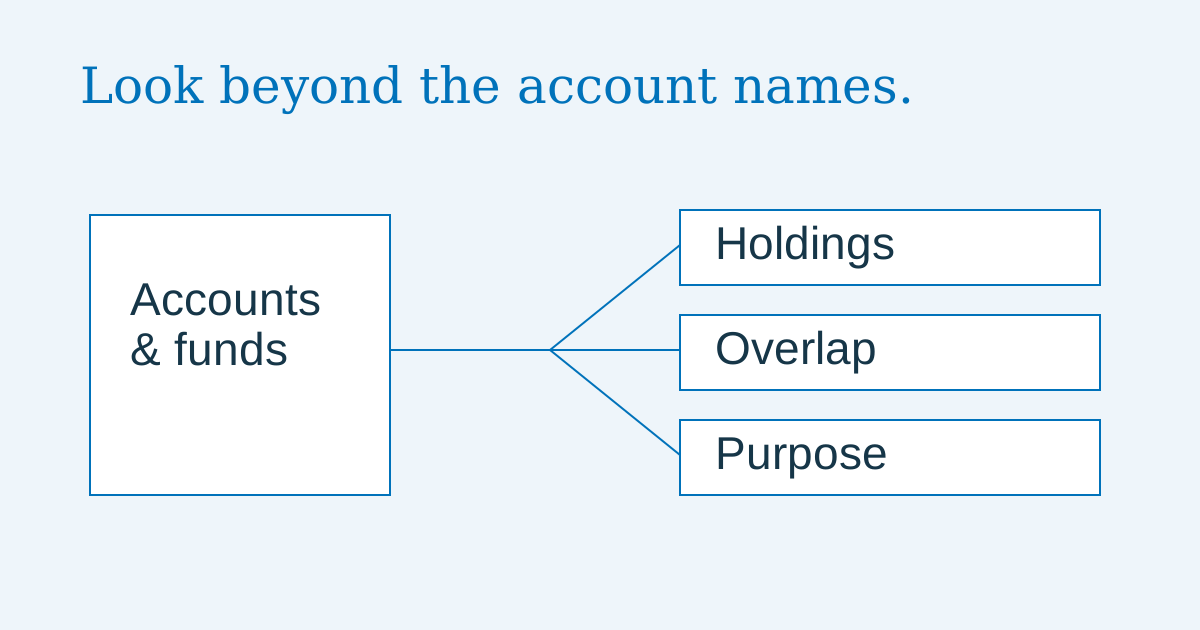
- Account
- Name the account, owner, and current statement date.
- Purpose
- Connect the account to a goal or a role in the household plan.
- Holdings
- List the fund, security, or option and the information source.
3. Check the mix across asset categories
Once the inventory is together, look at the categories underneath it. Stocks, bonds, cash equivalents, and other assets can behave differently, but labels alone do not tell the full story. The SEC describes asset allocation as dividing a portfolio among categories such as stocks, bonds, and cash, with the appropriate mix depending on the investor’s time horizon and risk tolerance. That makes this a question about fit, not a scorecard with one correct percentage.
Ask whether the combined mix reflects the money’s purpose and how much uncertainty the household can reasonably accept. Someone may discover that a short-term need is exposed to more fluctuation than they realized. Someone else may find that a long-term goal is being viewed separately from the time it has to work. Neither finding tells you what transaction to make. It gives you a more specific question for a thoughtful review.
Be especially careful with descriptions that sound safer or riskier than they are. A bond fund can have different interest-rate, credit, and duration risks. A cash-like vehicle can have different protections and limits. A fund’s name is only a starting point. Read the current fund documents and consider asking what risks matter most for the role it plays in your plan.
4. Look through funds to find overlap
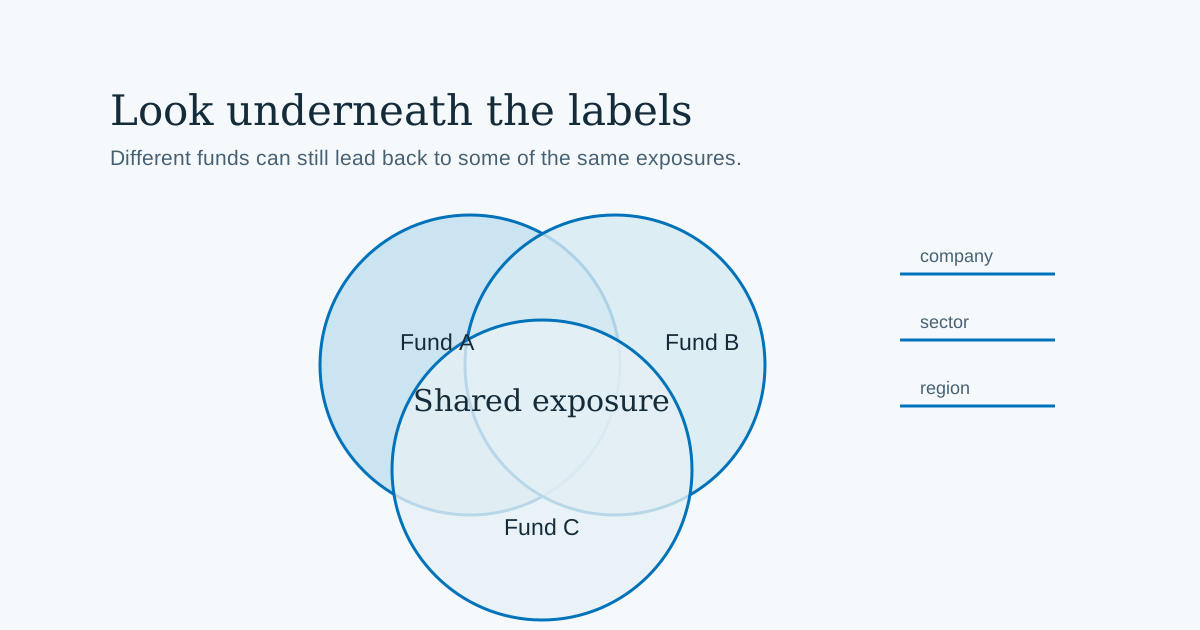
Holding more funds does not automatically mean holding more diversification. Several funds can own many of the same companies, lean toward the same sector, or depend on the same region. A large number of line items may create the appearance of variety while leaving the portfolio more connected to one outcome than expected. The relevant question is not “How many funds do I own?” It is “What do these investments add up to when viewed together?”
Start with the information you can verify: each fund’s objective, top holdings, sector breakdown, geographic exposure, and investment style. Compare two funds that appear to serve a similar role. The fund names may differ while their largest positions overlap substantially. Recent Vanguard investor guidance on checking diversification similarly suggests reviewing top holdings, sectors, and regions rather than relying on labels alone.
Overlap is not automatically an error. A household may intentionally hold a concentrated position, an employer-related holding, or a focused investment with a known tradeoff. The useful next step is to name the concentration, understand why it exists, and decide whether it still fits the goal and risks the household is willing to accept.
5. Test for concentration without assuming it must be removed
A diversification gap can be a concentration in one company, industry, region, asset type, or investment style. It can also arise when several accounts are managed independently and no one has looked at the combined exposure. A review should make these concentrations visible, then ask what they would mean if that area struggled or if the household needed money during a difficult period.
Write down the reason a concentrated holding exists. It may have come from an employer plan, inherited shares, a long-held investment, a tax consideration, or a deliberate preference. The explanation matters because a change can involve taxes, trading costs, plan restrictions, or a shift in risks elsewhere. Concentration is a fact to understand before it becomes a decision to act on.
It can help to frame the question in plain language: “If this one area fell sharply, which goal could be affected?” That is more useful than reacting to a headline or to a short period of performance. No allocation can remove market risk or guarantee a favorable outcome. A review can only help clarify which risks are present and whether they are deliberate.
- Exposure
- Which company, sector, country, or asset type appears most often?
- Reason
- Why is it held, and is that reason still current?
- Impact
- Which goal could be affected if that area performs poorly?
6. Include costs, taxes, and account rules in the picture
Diversification cannot be evaluated only by comparing holdings. A proposed change can have costs and consequences that differ by account. Selling in a taxable account may create a tax question. Moving money in an employer plan may involve limited investment options. Combining holdings can change fees, liquidity, or the way a portfolio is managed. These considerations do not make a review impossible. They are the reason a review should not rush from observation to action.
The SEC notes that adding more investments can add fees and expenses, which can reduce returns over time. That does not mean fewer investments are always better. It means each holding should have a clear purpose, and costs deserve a place in the conversation. Keep a list of expense information, transaction limits, and any questions for your tax professional or plan administrator.
When a household has several types of accounts, the location of an investment can be just as important as the investment itself. Bring the account rules into the discussion before making changes. The aim is to see the tradeoffs clearly, not to force every account to look identical.
7. Turn the review into questions, not automatic trades
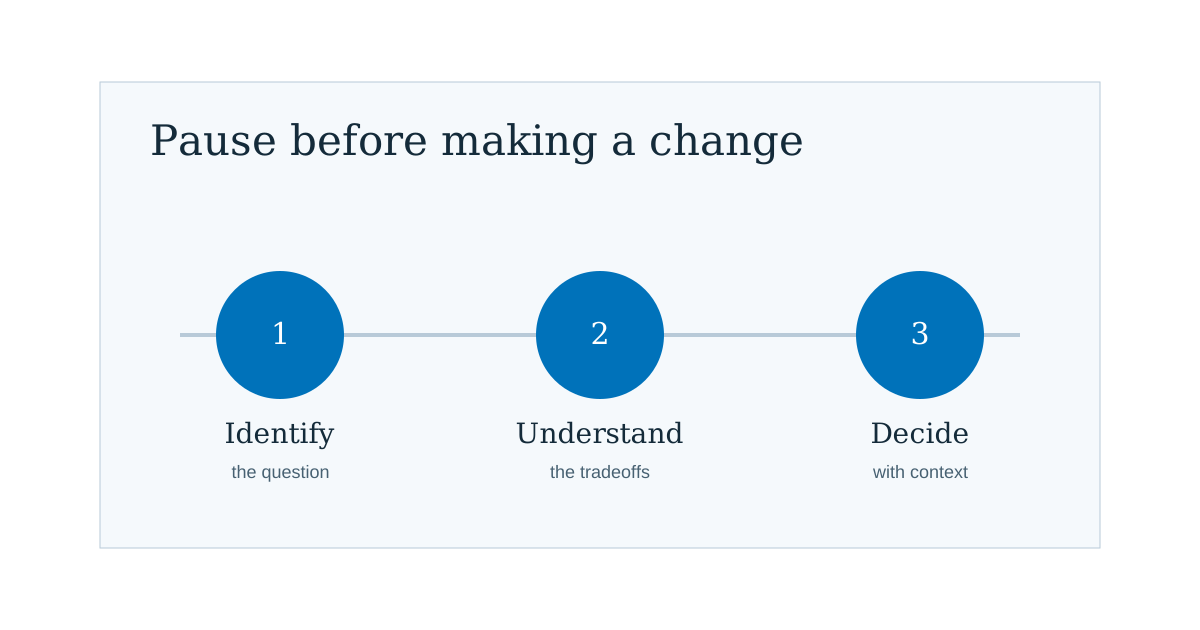
A checklist is most helpful when it produces a short list of well-defined questions. You might ask whether two funds serve the same role, whether a large holding is intentional, whether the mix still matches an approaching retirement date, or whether an account restriction needs clarification. That is a stronger result than a vague conclusion that the portfolio should be “more diversified.”
Give each question an owner. A plan administrator may need to explain employer-plan options. A tax professional may need to address a potential transaction. An attorney may need to consider a trust or inherited account. An Investment Advisor Representative can help connect the investment questions to the broader plan. This coordination is particularly useful when investments, withdrawals, taxes, and benefit decisions affect one another.
Investor.gov’s preparedness checklist also encourages investors to understand risk tolerance, fees, and investment research. Use those themes to guide a conversation, and avoid making a change simply because a chart, headline, or a single performance period makes it feel urgent.
How Shrier Associates can help with the conversation
A useful investment review begins with the life the portfolio is meant to support. At Shrier Associates, financial planning and investment management are considered together with your goals, timing, spending needs, and the questions that may involve other professionals. You can explore our financial planning and investment management services or use the contact page to begin a conversation.
Bring the records you have, a list of the accounts involved, and the questions that feel unresolved. The goal is not to arrive with a preselected trade. It is to leave with a clearer picture of what you own, what it is meant to do, and what deserves careful follow-up. This article is for general education and is not individualized investment, tax, or legal advice.
Frequently Asked Questions
How can I tell whether my portfolio has diversification gaps?
Start by viewing relevant accounts together, then compare the actual asset categories, top holdings, sectors, regions, and investment styles beneath the fund names. A gap may be a concentration or an overlap, but the right response depends on your goals, time horizon, taxes, account rules, and risk tolerance.
Do more funds always mean better diversification?
No. Different funds can hold many of the same companies or lean toward the same sector or region. More line items may add complexity without changing the combined exposure. Reviewing what each holding contributes is more useful than simply counting funds.
Should I sell an investment if I find overlap?
Not automatically. Overlap can be intentional, and a change may involve taxes, costs, restrictions, or other tradeoffs. First identify the purpose of each holding and the impact of the combined exposure, then discuss any decision in the context of your personal circumstances.
How often should I review diversification?
A review may be useful after a meaningful life, account, or goal change, and as part of a regular planning rhythm. The appropriate timing depends on the household and the investments involved. Avoid treating routine market movement as a reason for an automatic change.