


Our November 6, 2026 letter considers the technology selloff, AI spending concerns, and the value of a long-term perspective.
Read the complete two-page special market update below, including the original sources and disclosures. Open the PDF for zoom controls, or jump to the reading text.
Open Special Market Update (PDF)Yesterday’s (Tech) Selloff There are jittery markets, and then there are markets like yesterday, where it seemed like the quick-twitch traders were in a full-blown panic about their stock holdings. (This, of course, after they bid up stock prices in a giddy aftermath to the midterm elections.) Most of the negative action seemed to hit the large tech firms whose fortunes are increasingly tied to artificial intelligence, and which have lately been making up a big part of the S&P 500’s total capitalization. But then the herd started, and the traders started selling everything. What’s the big deal? In the midterm election cycle, it seemed as if both Republican and Democratic voters agreed on at least one issue: they don’t want the large tech companies building giant data centers all over the country. Building giant data centers is basically what the large tech firms do lately when they’re not pell mell training more sophisticated AI agents and, at the same time, warning anybody who would listen that more sophisticated AI agents pose a dire threat to the human race. So (the reasoning goes) if the large tech firms are going to be prevented by voters (and alert politicians who listen to them) from borrowing billions to build ever-larger data centers, those firms must be less valuable and their future is limited. Sell! The result: Shares of chipmakers Broadcom and Nvidia were down 10% and 9% respectively, the iShares Semiconductor ETF was down 12%, Oracle dropped 7%, while Microsoft ($117 billion), Apple ($59 billion), Amazon ($55 billion), Meta ($58 billion) and Alphabet ($42 billion) all saw their aggregate share prices drop dramatically. The irony is that this hostile political climate might not be such a terrible outcome for the large tech firms in question. A pause in spending billions and even trillions of dollars on construction and large piles of Nvidia chips might allow the revenues of those firms to catch up a bit with their spending. And meanwhile, is it a terrible outcome if the AI agents they’re building evolve their cleverness a tad less rapidly? What we have now is undeniably useful, although corporate users are still trying to figure out how to put the silicon-based workers to effective work. So what can we expect going forward? Who knows? If anybody can reliably predict the behavior of the quick-twitch trader herd, particularly in the short-term, then this would be a good time to raise your hand. Otherwise, the best prediction might come from a century of long-term market behavior, which tells us that all the workers who go to the office or plant day in, day out will make their companies steadily, incrementally more valuable, regardless of what a nervous trader might think in the moment. There are times when doing nothing is actually harder than reacting to the general panic, but the markets have taught us that doing nothing has always been the better long-term approach. That might even be true for the pell-mell builders of billion-dollar data centers in the current political environment. Sources: https://www.cnbc.com/2026/11/04/stock-market-today-live-updates.html https://www.bloomberg.com/news/articles/2026-11-04/stock-market-today-dow-s-p-live-updates https://finance.yahoo.com/markets/live/stock-market-today-thursday-november-5-dow-sp-500-nasdaq-plunge-chip-stocks-melt-down-193726491.html Disclosure: This piece is for informational purposes only and contains opinions that should not be construed as facts. Information provided herein from third parties is obtained from sources believed to be reliable, but no representation or warranty is made as to its accuracy or completeness. Charts and graphs are for illustrative purposes only. Past performance is not indicative of future results. Any indices shown are not available for investing. If there is discussion of any specific strategy, it is not intended as a guarantee of profit or loss. If objectives are mentioned, there is no guarantee that it will be achieved. RiskFirst® is a registered trademark of Redwood Investment Management, LLC. Objectives mentioned are not guaranteed to be achieved. Associates LLC is a state registered investment adviser. Such registration does not imply that the adviser as reached a certain level of skill or ability and no inference to the contrary should be made. Please see firm’s Form ADV Part 2A (Brochure) for more information on investment risks and strategies. Redwood and Shrier Associates LLC are not affiliated entities. Consumer Price Index (CPI) measures the overall change in consumer prices based on a representative basket of goods and services over time. 619 Devenwood Way, Clinton, MA 01510 | 5 Farleigh St. Suite 305, Asheville, NC 28803 508.898.9500 | rick@shrierassociates.com | shrierassociates.com
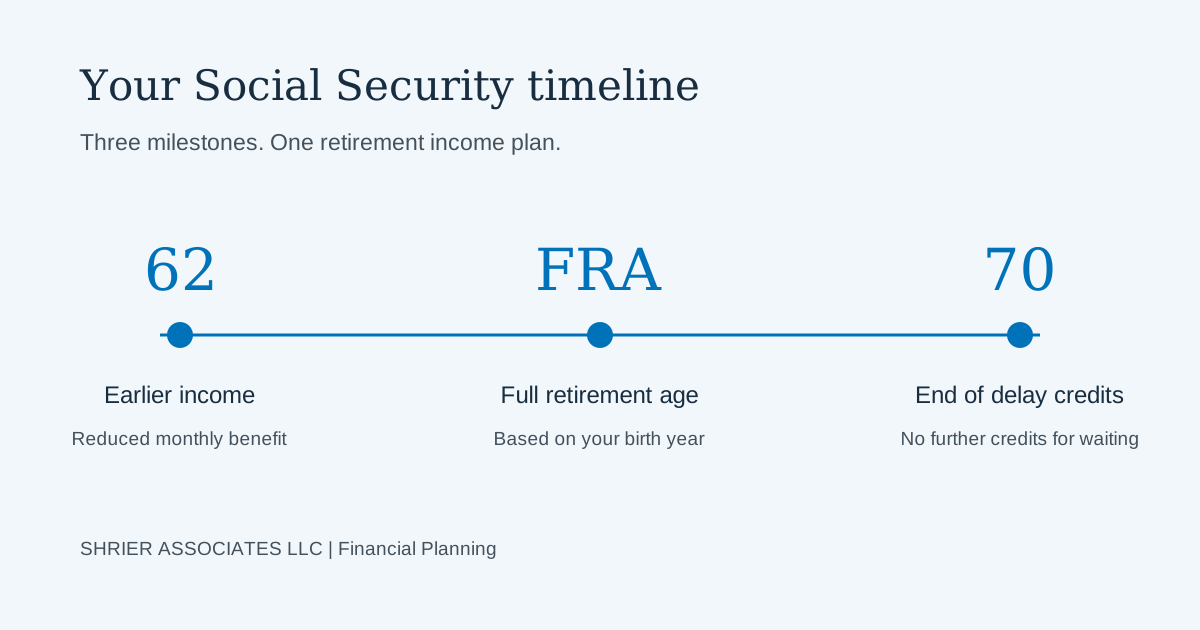
Explore Social Security claiming ages, work, taxes, and family benefits, with practical takeaways from our Social Security presentation.
Read Article →
Organize your spending, income, healthcare questions, and investment decisions before you make the transition to retirement.
Read Article →